Showing posts with label sugar. Show all posts

Tuesday, 14 April 2015

Sugar: the bitter truth


Some of the things that Robert Lustig is saying need to be widely understood and only 5.4 million have watched his you tube video so far.

Obese 6 month year olds

The story he tells is particularly relevant if you care about your children's health. They are the most in danger from the abuse by the industrialized food toxin producers and marketers. He advises of a current obesity epidemic in 6 month old babies and shows that baby formula is no more than sugar laden milkshake. He warns that adult cravings for sugar are set in infancy.


Atkins and Japan diet same difference

The high carb/low fat diet of Japan and high fat/low carb diet as per Atkins are diametrically opposed, but they both work. People will not be overweight by following either diet, what makes these diets work is that they both exclude added fructose.  In these diets fructose would only be consumed in smaller amounts and as part of whole fruits.

Dr Lustig asserts that fructose is in fact a poison to humans and similar to alcohol. In nature we are protected from the ill effects of fructose by the fibre in fruit, plus the fact that historically fruit was not available all year round.

Obesity rates in US have jumped since the 1960s despite people consuming less fat. The rise in obesity is due to Americans consuming more sugar and in particular from the 1970s increasing amounts of high fructose corn syrup (HFCS).  

Fat Consumption Down, Fat Bodies Up


Dr Lustig considers Ancel Keys' findings were mistaken regarding the correlation between high fat intake and high incidence of heart disease. He states that, the entire nutrition advice and policies in the US are wrong and are based on the erroneous findings of Ancel Keys.

Low Fat High Carb (Sugar) Diet is Causing Heart Disease

Dr Lustig accepts that eating a diet high in fat increases cholesterol, he explains that this is the harmless "LDLa" cholesterol which is large and buoyant and does not cause heart disease. However, eating a diet high in carbohydrates, and in particular sugars, increases the small dense cholesterol "LDLb", which damages the arteries and allows the plaque build up causing heart disease.

A major factor in the American diet leading to the obesity is consumption of excessive fructose contained in HFCS an ingredient in many processed foods, including soft drinks. He points out that fructose is actually toxic to our bodies and causes the following problems. 

  • Fructose does not suppress the hunger hormone Ghrelin that stops us feeling hungry so we tend to overeat. 
  • Fructose causes us to produce uric acid, which causes high blood pressure and also gout.
  • Fructose causes high amounts vLDL (triglycerides) to be released into the blood stream causing obesity, type 2 diabetes and heart disease.  
  • Fructose damages the liver and causes non-alcoholic fatty liver disease (NAFLD) and causes liver insulin resistance.
  • The impact of fructose on the liver is similar to alcohol and leads to cirrhosis. There are reports of children requiring liver transplants and dying of cirrhosis due to NAFLD.  
By comparison he notes that glucose is the fuel of life and that the metabolism of glucose is not harmful to our liver.

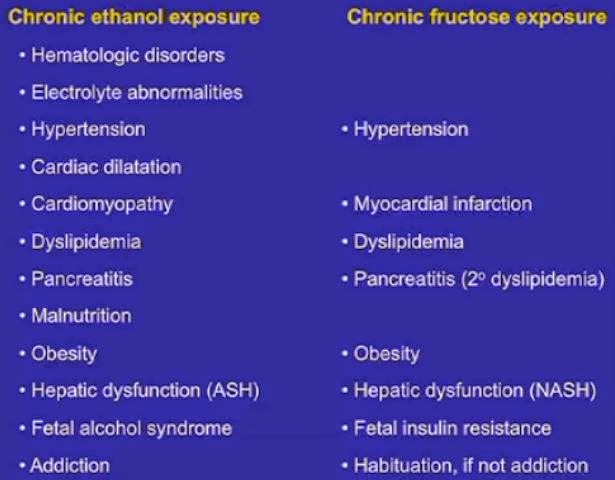
Fructose on other hand is closely related to alcohol and similarly toxic and causes many of the same or similar diseases as alcohol. 
  

From an experiment on medical students eating the same amount of calories in glucose or fructose the amount of vLDL (triglycerides) released from consuming fructose was 20 to 30 times that of glucose.

He claims that the US Department of Agriculture won't do anything about excessive HFCS in our processed foods as this would harm the food producing industry and that food exports are important for the US economy. 

Saturday, 4 April 2015

What are carbohydrates and are they making us fat?


Carbohydrates are molecules containing carbon, hydrogen and oxygen. They supply us with the fuel-energy that enables us to function.  Proteins and fats are other energy sources. Carbohydrates consumed in excess of our energy needs, are quickly transformed into stored fat within our bodies.

For years there has been debates concerning the optimum diet to achieve weight loss including “low fat high carb diets” and “low carb high fat diets.

Increasingly there is growing evidence to support that “low carb high protein diets” are more effective than “low fat high carb diets” in the management and control of our weight and stored body fat.

Our Government Health Authorities and many main stream nutritionists are conservative and resistant to change their views in the face of the growing scientific evidence against the previously perceived wisdom to reduce fats and exercise strict calorific control.

Contrary, we need to stop counting calories and eat until we are full. We need to count our carbs and in particular the bad processed carbs, from Ronald Mac etc.. It has been proven many times that by restricting carb intake, not calorie intake, we will lose weight.

The key concern it seems for many of main stream nutritionists is that a “low carb high fat diet” will cause heart disease. However, increasingly the scientific evidence is showing this may be fallacy not based on real scientific evidence and not all fat is bad. The real culprit causing obesity and heart disease is added sugar in our diet and which is pervasive in so many of our processed foods including low fat foods.   

Kris Gunnars, of authoritynutrition.com has undertaken a review of 23 respected gold standard scientific studies which compare “low fat” and “low carb” diets. The chart below is a summary of the results and shows that “low carb” resulted in greater weight loss


So what are carbohydrates in terms of food and do we need them?

Carbs consist of three different groups:-

Starches, which are found in vegetables and grains and are referred to as “complex carbohydrates”. Complex carbs provide the body energy more immediately than consumed fats and protein and are a key fuel for the brain and nervous system.  Complex carbs or starches, unlike sugars are released into the blood stream slowly and so you will not crash and crave bad carbs later in the day.

Sugar on the other hand is a simple carbohydrate and it is released very quickly into the blood stream giving an energy boost. Sugars are naturally occurring in the fruit we eat. They are also added into the numerous processed foods (toxins) that we consume. Added sugar is the major cause of obesity, metabolic syndrome and type 2 diabetes.

Fibre is only found in whole fruit (not in juice), vegetables and whole grains. It promotes a healthy digestive system and is key to preventing gut cancers. There are two types of fibre insoluble and soluble. Soluble fibre reduces the amount of bad cholesterol (LDL) within the blood stream. Porridge in particular contains soluble fibre which soaks up bad cholesterol. Insoluble fibre is not digested but helps your digestive system to move and remain healthy.

Another benefit of eating sufficient fibre, is that it makes us feel fuller longer without being hungry.

Carbohydrates (apart from sugar) provide significant benefits to our health and well-being. So what is the problem?  The first is consumption of too much sugar and in particular added sugar and then refined grains where the fibre and other nutrients have been stripped out. Carbs are good but in moderation and only the complex ones.

How many carbs should we eat?
 
Let us, look at the National Health Service (NHS) in UK "Eat Well Plate" and calculate the amounts of the different types of food it may represent.


It is split into 5 segment food groups as follows:

  • bread, rice, potatoes, pasta and other starchy foods - 33%
  • fruit and vegetables - 33%
  • milk and dairy foods - 15%
  • meat, fish, eggs, beans and other non-dairy sources of protein - 12%
  • foods and drinks high in fat and/or sugar - 8%

 
Typical Foods and Quantities to Follow NHS Eat Well Plate Guidelines  


Observations

In carbs category the energy density varies quite a lot. In aiming for weight loss it may be better to target foods with lower energy density. In this way you will feel fuller by eating a greater volume of food with less calories by weight. Rice and potatoes are better choice than bread and pasta.

If you only ate spinach you would need to eat 3kg to reach the recommended calorific guidelines. This is not realistic: unless you are a gigantic rabbit.

We need a paradigm shift in considering how much vegetables we consume and to increase them substantially. By blending whole vegetables you can increase the quantities of vegetables you consume. 

The quantity of sugar in fruit are high.  If you are aiming for weight loss it is better to increase your green vegetable intake more than your fruit intake. Personally I am careful of fruit sugar (fructose) and 3 pieces of fruit a day is plenty.

Summary of carbohydrate intake by following Eat Well Plate


So how much carbohydrate should we eat for weight loss and would the NHS “Eat Well Plate Guidelines” allow us to achieve weight loss?

We can discount fibre as that is mainly passing through and only count the starches and sugar and the total amount of carbs by following the NHS “Eat Well Plate Guideline” is 300g.

This amount of carbs is far in excess of what will allow us to lose weight without restricting calories in other foods and so feeling hungry.

The answer to how many carbs we should eat to lose weight varies from person to person, but the range is much lower than 300g. To lose weight you need chose one.

Greater than 150g carb (half NHS amount). You need be on calorie restriction plus exercises to lose weight. You may feel hungry.

Equal or less than 150g carb intake per day. You need to exercise to lose weight, but can eat more protein and fats. This may be the maintenance range once you have lost weight.

50g to 100g carb. If you increase protein and fat intake you will not feel hungry. Also by eating only complex carbs, such as starch you will have immediate energy. Porridge Oats are recommended. By staying in this range for carbs you will lose weight easily and by eating protein and healthy fats until you feel full and not go hungry. You should undertake light aerobic and some resistance exercise to maintain muscle mass.

50g or less, this is “Atkins” territory. It is effective for fat loss but not sustainable for most people overtime. Plus you will smell of bad decay.   

The gram amounts above only include starch and sugar. Fibre and "resistant starches" may be disregarded in counting carbs. 

When undertaking weight reduction it is key to do it at a sustainable pace and also undertake strength/resistance training to maintain muscle mass. Regular aerobic exercise also reduces blood sugar, helps reverse metabolic syndrome and allows the body to burn fat stores.


Friday, 3 April 2015

Why we tend to gain weight as we age?


Many of us gain weight as we age; why is this? 
We don't eat more and often we eat less than we did, so why are we fatter?
The answers are in the following.

  • Lower Metabolic Rate
  • Lower Physical Activity
  • Reduced Muscle Mass
  • Insulin Resistance
  • Stress and anxiety
  • Poor diet
 

What can we do about it


Increase our metabolic rate through regular exercise, exercising 3 to 4 times a week for 30 minutes is a good place to start. Increase and maintain our muscle mass by including resistance exercises in our programs. Increased muscle mass = Increased metabolic rate. This is for both men and women.

 
Reduce our intake of carbohydrates with sugar being the major culprit causing obesity, metabolic syndrome and insulin resistance. Keep your carb intake between 50g and 100g per day and the pounds will drop off. 


Stress and anxiety cause hormonal imbalances that can increase blood fat and sugar levels. These can directly cause weight gain and worse lead to heart disease. 

Through exercise our bodies will release endorphins elevating our mood. Exercising also enables us to be more single focused and 'in time' reducing worries and irritations, and allowing to put them in perspective.


A healthy balanced diet is fundamental to losing body fat and maintaining a healthy weight. For many it is not about calorific restriction but about changing what we eat to include real foods and to avoid processed foods which provide little or no nutrition and cause hormonal imbalances (insulin resistance and metabolic syndrome) that can cause us to pile on the pounds.

Summary

There are three key points to losing weight and gaining the healthy body we deserve:- exercise, nutrition, and stress management. By just taking small measures in any of these areas you are bound to see improvements and by taking greater measures the benefits will snowball.

It doesn’t have to be hard in fact it can’t be or you won’t do it. 
People who are in good shape do it because it is enjoyable it becomes addictive once get over the inertia. So make a plan and try it out, you will surprise yourself and may find you enjoy life more. Visualise the slim attractive you and how you will feel in only a few weeks. The summer is coming.